
Before Hamilton revolutionized Broadway, before La La Land reinvented movie musicals for millennials, and long before Joker: Folie à Deux merged comic book culture with musical elements, there was the 1960s—the decade when cinema and musical theater experienced their most dramatic identity crisis.
The 1960s wasn't just another decade in film history; it was cultural ground zero where Old Hollywood's studio system crumbled while counterculture revolutionaries stormed the gates. This was the era when filmmaking simultaneously achieved its most lavish traditional spectacles and its most radical experimental breakthroughs. For the movie musical—a genre that had defined Hollywood's Golden Age—the 1960s represented both a spectacular final bow and the first notes of a dramatic reinvention.
This article explores how the revolutionary spirit of the 1960s transformed cinema forever, how the musical genre fought to remain relevant in rapidly changing times, and why this pivotal decade's innovations continue to influence today's entertainment landscape—from Glee to Schmigadoon! to the latest TikTok musical trends.
The Revolution of 1960s Cinema
The 1960s didn't just change cinema—it completely revolutionized it in ways that parallel today's streaming disruption. While modern audiences witness the battle between theatrical releases and streaming platforms, 1960s audiences experienced the collapse of the old studio system and the birth of New Hollywood.
The Perfect Storm of Cinematic Revolution
The Death of the Studio Monopoly Just as streaming services have broken network television's dominance, the 1948 Supreme Court antitrust ruling forcing studios to divest their theater chains finally bore fruit in the 1960s. This judicial earthquake created space for independent voices in the same way digital platforms have democratized content creation today.
The International Wave Directors like François Truffaut, Federico Fellini, and Ingmar Bergman weren't just foreign filmmakers; they were the 1960s equivalent of viral sensations, introducing American audiences to narrative techniques that felt strikingly similar to how Korean cinema (Parasite) and international streaming hits (Squid Game, Money Heist) have recently transformed American viewing habits.
Reality Bites The shift toward gritty realism in films like Midnight Cowboy and The Graduate mirrors our current obsession with authentic, unfiltered content across social media. These films rejected Hollywood gloss in favor of raw truth—essentially becoming the 1960s version of “no filter” content.
Youth Culture Revolution When Easy Rider and Bonnie and Clyde captured the anti-establishment mood, they did for Baby Boomers what Euphoria and Dune have done for Gen Z: reflect their generation's anxieties, aesthetics, and aspirations in viscerally relevant ways.
Epic Excess and Its Downfall The early 1960s obsession with expensive epics like Cleopatra feels remarkably similar to today's superhero franchise fatigue. Both represent industries doubling down on costly spectacles before recognizing the need for more diverse, creator-driven storytelling.
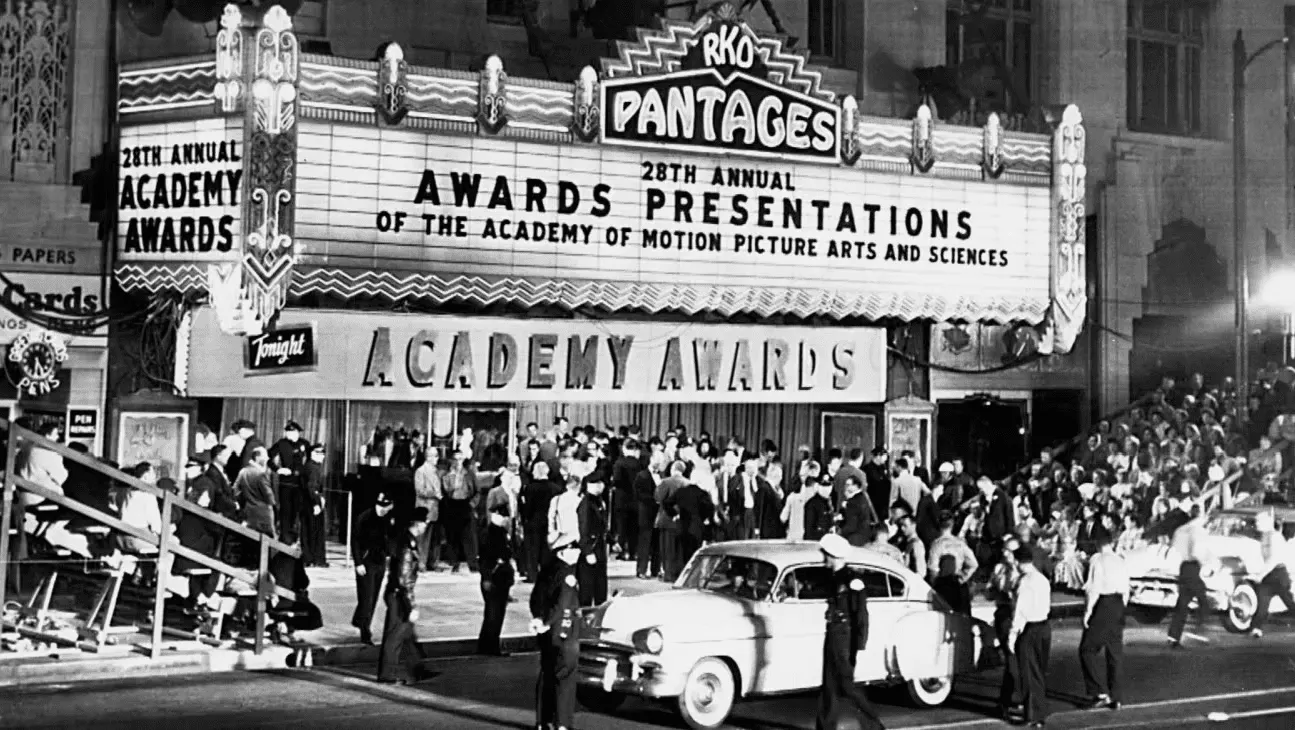
The 28th Annual Academy Awards, arrivals at the Pantages Theatre in 1956.
In this revolutionary environment, the movie musical—previously Hollywood's comfort food—suddenly seemed as outdated as cable TV in a streaming world. But like today's innovative musical content creators adapting to TikTok and YouTube, the genre sought ways to evolve rather than disappear.
Musicals at the Crossroads
While today we celebrate the diverse musical expressions of Encanto, Tick, Tick… Boom!, and Spielberg’s West Side Story, the 1960s musical found itself trapped between traditional spectacle and radical reinvention. This tension created a fascinating transitional period with striking parallels to our current entertainment landscape.
The Last Hurrah of Classic Musicals
The blockbuster Broadway adaptations of the 1960s represented the last stand of Old Hollywood's approach to musicals—lavish, family-friendly spectacles that prioritized escapism over relevance:
The Sound of Music (1965)The cinematic equivalent of a viral phenomenon, this film's overwhelming success mirrors how Hamilton broke outside traditional theatrical audiences to become a cultural touchstone. However, its success created the same problem facing superhero films today: studios trying to replicate a formula instead of understanding the specific magic that made it work.
Oliver! (1968)As the last musical to win Best Picture until Chicago 34 years later, Oliver! represents the end of an era, much like Titanicmarked the twilight of the pre-CGI blockbuster. Its victory over more inventive films reflects the industry's reluctance to embrace change—a pattern we still see in award shows today.
Hello, Dolly! (1969)This expensive, star-studded production that underperformed financially feels remarkably similar to recent musical film struggles like Cats and Dear Evan Hansen—lavish productions that failed to connect with audiences despite built-in fanbases.


Comedy, Satire, and Breaking Traditions
As the decade progressed, musicals began experimenting with format and tone, embracing irreverence and satire in ways that feel remarkably modern:
A Funny Thing Happened on the Way to the Forum (1966) Sondheim's adaptation prioritized comedy over traditional musical elements, anticipating shows like The Book of Mormonand Something Rotten! that use musical conventions to satirical effect. The stage musical originally premiered on Broadway in 1962, and after the film's success, it was revived on Broadway in 1972, 1996, and 2015.
How to Succeed in Business Without Really Trying (1967)Its satirical take on corporate America feels like the 1960s version of Sorry to Bother You or The Wolf of Wall Street—using genre conventions to deliver sharp social commentary. After beginning as a stage musical in 1961, the film adaptation's success helped spur major Broadway revivals in 1995 and 2011, the latter starring Daniel Radcliffe.
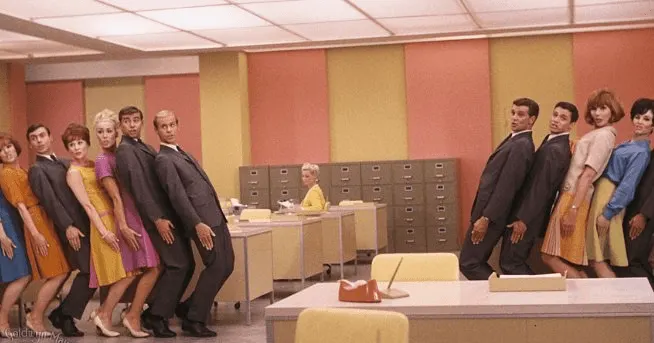
Thoroughly Modern Millie (1967) This pastiche of 1920s musicals shares DNA with modern meta-musical content like Schmigadoon! and Crazy Ex-Girlfriend. In a rare reverse adaptation, the film was transformed into a Broadway musical in 2002, winning six Tony Awards.


The Beatles: Rock’s Invasion of Film
While The Beatles weren't creating traditional Broadway adaptations, their revolutionary approach to merging music and film created the blueprint for the rock musical explosion that followed.
A Hard Day's Night (1964)Established a new visual language for rock performance, blending narrative, documentary spontaneity, and musical expression.
Help! (1965)Its surreal adventure narrative influenced concept albums turned films like Pink Floyd’s The Wall.
Yellow Submarine (1968)Demonstrated how music could build an immersive, animated world driven by theme rather than plot.
These experiments planted the seeds for rock musicals such as Jesus Christ Superstar, The Wiz, and Labyrinth.
Broadway Revolutionaries Who Conquered Hollywood
Jerome Robbins His choreography for West Side Story translated theatrical movement into cinematic language that continues to influence dance-forward storytelling.
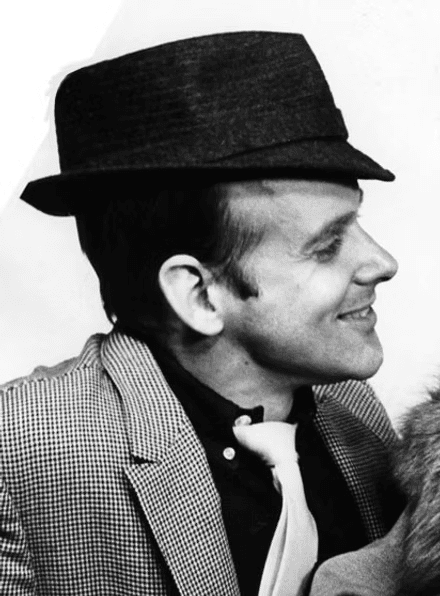
Bob Fosse
Beginning with Sweet Charity (1969), Fosse’s move from Broadway to film mirrors modern multi-hyphenate creators. His visual style remains deeply influential.
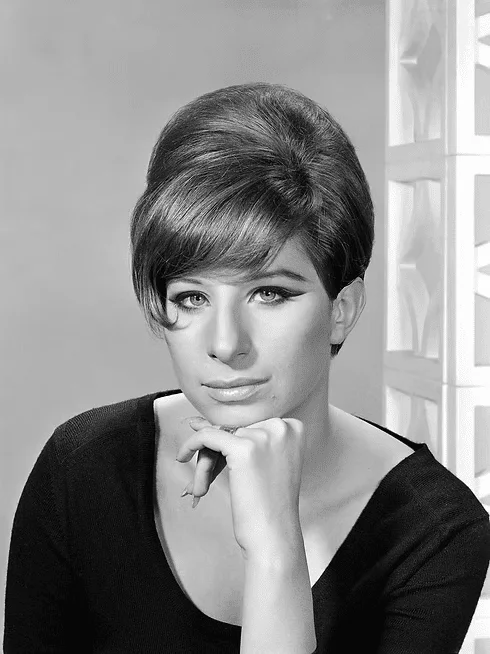
Barbra Streisand
Her transition from Broadway to Hollywood stardom in Funny Girl (1968) created the template for performers who move fluidly between stage, music, and screen.
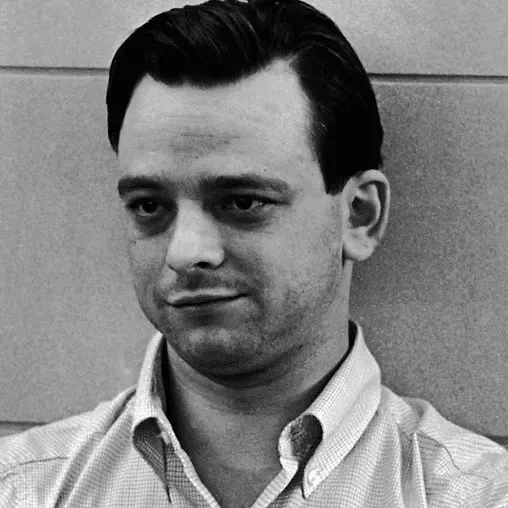
Stephen Sondheim
His early Hollywood experience revealed the enduring challenges of adapting complex musical works for film—issues that still surface in contemporary adaptations.
The Sound of Music: The Blockbuster That Changed the Game
When The Sound of Music conquered box offices in 1965, it didn't just break records—it redefined what a blockbuster could be, becoming the Avengers: Endgame of its era. This phenomenon directly parallels today's entertainment landscape, where studios chase established IP and proven formulas.
The film's success contains a paradox that still haunts Hollywood: it simultaneously validated the traditional musical while creating impossible expectations for the genre. Just as Marvel's success led to countless failed shared universes, The Sound of Music triggered expensive musical flops as studios tried replicating its success without understanding its unique appeal.
Modern viewers revisiting the film on Disney+ might be surprised by how it balances spectacular Alpine imagery with intimate character moments—a blend of scale and heart that today's most successful franchise films still strive to achieve.
Oliver!: The Last Gasp of Traditional Glory
Oliver! (1968) winning Best Picture represents a fascinating historical moment comparable to Green Book winning over more innovative films like Roma and Black Panther—an instance where the industry rewarded familiar tradition over challenging innovation.
As the last musical to win Best Picture until 2002's Chicago, Oliver! marks the end of the era when musical films automatically received serious Oscar consideration. Today's musicals face similar challenges breaking through with Academy voters, with notable exceptions like La La Land having to reinvent the genre to gain recognition.
The film's lavish production design and traditional approach feel increasingly out of step with the cinematic revolution happening around it—much like how traditional blockbuster filmmaking now exists alongside boundary-pushing streaming content.
Funny Girl: When Star Power Transformed the Genre
Barbra Streisand's film debut in Funny Girl (1968) demonstrates how star power can reinvent a genre, establishing a pattern followed by everything from A Star Is Born to The Greatest Showman. Her commanding performance introduced a modern sensibility to musical protagonists that feels remarkably contemporary.
Unlike other musicals of the era, Funny Girl succeeded by focusing on character and performance rather than spectacle—an approach that modern character-driven musical films like Rocketman continue to employ. Streisand's boundary-breaking talent mirrors recent breakthrough performances from artists like Lady Gaga, transitioning from music to film.
The film's emphasis on a strong female protagonist struggling with career and relationship also resonates with current conversations about women's representation in film, making Funny Girl feel surprisingly relevant to contemporary viewers.
A Funny Thing Happened: Sondheim's Hybrid Experiment
A Funny Thing Happened on the Way to the Forum (1966) marks a significant moment in film musical history as Stephen Sondheim's first major work adapted for the screen. Unlike other musicals of the era, this adaptation revealed a fundamental challenge that would define Sondheim's relationship with Hollywood for decades to come.
Director Richard Lester made a critical creative decision for the film version—he cut several of Sondheim's original songs while emphasizing the slapstick comedy and vaudevillian elements. This established a pattern we've seen repeated with nearly every Sondheim adaptation since, from Sweeney Todd to Into the Woods: filmmakers struggling to balance Sondheim's musical complexity with cinema's demand for visual storytelling and broader audience appeal.
The film succeeded as comedy but compromised as a musical showcase, beginning what many theater critics consider Hollywood's complicated history with Sondheim's work. This tension between preserving theatrical sophistication and creating accessible cinema continues with recent musical adaptations like Dear Evan Hansen and In the Heights, where songs are cut, narratives streamlined, and thematic elements simplified to fit film conventions.
The Beatles Films: The Disruptors That Changed Everything
The Beatles' cinematic experiments fundamentally changed how music functions in film, creating templates still followed by visual artists from Beyoncé to Bad Bunny:
A Hard Day's Night (1964) pioneered the documentary-style band film, creating a template that artists from Madonna (Truth or Dare) to Taylor Swift (Miss Americana) have followed to shape their public narratives.
Help! (1965) established the foundation for the rock opera film. Its surrealist plot, fantasy sequences, and integration of musical performances as essential storytelling elements directly led to ambitious rock operas like The Who's Tommy(1975), Pink Floyd's The Wall (1982), and even Prince's Purple Rain (1984). By proving that a popular rock band could create a successful musical film that wasn't confined to traditional structures, Help! gave artists permission to use cinema as an extension of their musical vision rather than forcing their music into conventional film formats.
Yellow Submarine (1968) demonstrated how a band's musical catalog could create a fully immersive alternate universe, influencing concept albums turned into theatrical experiences. The film's psychedelic animation and loose narrative structure rejected movie musical conventions entirely, instead treating songs as portals to fantastical worlds—an approach later seen in rock musicals like The Rocky Horror Picture Show (1975) and cult favorites like Phantom of the Paradise (1974).
Legacy: How the 1960s Musical Shaped Entertainment Today
The 1960s represent not just a pivotal moment for musical films but a blueprint for how entertainment genres evolve under pressure from cultural and technological change:
Franchise Lessons – The industry's attempts to replicate The Sound of Music's success mirror modern franchise fatigue, demonstrating that authentic creative vision trumps formula.
Format Revolution – The Beatles' film experiments laid groundwork for music videos, visual albums, and social media music content that dominates today's landscape.
Star-Driven Reinvention – Barbra Streisand's impact shows how transcendent talent can revitalize traditional formats, a pattern repeated by modern stars who've breathed new life into musicals.
Genre Hybridization – The decade's experimental comedic musicals pioneered the genre-blending approach that allows today's content to merge musical elements with everything from horror (Sweeney Todd) to superhero films (Joker: Folie à Deux).
Cultural Relevance Cycle – The pendulum swing between escapist spectacle and socially relevant content in 1960s musicals continues today, with audiences alternately embracing comfort-food musicals like The Greatest Showman and challenging works like Tick, Tick… Boom!.
Today's entertainment landscape—where Hamilton breaks streaming records, pop stars create visual albums, and TikTok spawns the Ratatouille musical—owes its multifaceted approach to musical storytelling to the revolutionary experiments of 1960s cinema. By understanding this pivotal decade, we gain insight into not just where musical entertainment came from, but where it's heading next.
FAQs: The 1960s Cinema Revolution and the Movie Musical
How did 1960s musicals influence modern music videos?
The Beatles’ films introduced visual storytelling techniques—quick cuts, performer-focused narratives, surreal imagery—that became foundational to music videos and visual albums.
Was The Sound of Music the most successful movie musical ever?
It was among the most successful of its time and remains culturally dominant, though modern animated musicals now exceed its box office reach.
Why did traditional Hollywood musicals decline after the 1960s?
Rising costs, shifting youth culture, rock music’s dominance, and failed attempts to replicate past successes contributed to the decline.
How did Barbra Streisand change musical film performance?
She introduced a more naturalistic, emotionally grounded performance style that prioritized character over spectacle.
Did 1960s musicals engage with social movements?
Indirectly. Satire and shifting values appeared, but overt political engagement emerged more fully in 1970s musicals like Cabaret.
How did Bob Fosse reshape the movie musical?
Fosse brought psychological depth, stylized movement, and adult themes that anticipated later, more complex musical films.
What 1960s musical elements appear in modern streaming content?
Genre deconstruction, hybrid formats, performer-driven narratives, and experimental structure—all pioneered during this decade.


